How Colchester’s Humidity Levels Lead to Rapid Algae Growth

If you’ve noticed that your patio or driveway in North Essex turns green faster than a field in spring, you aren’t imagining it. Colchester’s unique geographical position—nestled between the Roman River and the Colne Estuary—creates a microclimate characterized by high humidity and damp air. While this might be great for the local flora, it is the primary reason for the rapid spread of algae and lichen on your property.
To protect your home, it’s important to understand the science behind this “green takeover” and why professional exterior cleaning Colchester is the only permanent solution.
The “Estuary Effect” and Surface Moisture
Humidity is essentially the amount of water vapor in the air. Because Colchester is close to the coast and surrounded by water systems, our relative humidity often sits well above the threshold required for organic spores to activate.
Algae, specifically green algae and cyanobacteria, do not have roots. They absorb moisture and nutrients directly from the air and the surface they sit on. When the air is humid, your stone surfaces stay “damp” long after the rain has stopped. This persistent moisture creates a “biofilm”—a thin, invisible layer of bacteria that allows algae to anchor itself to your paving.
Why Colchester’s Stone is Under Attack
Most patios in our area are constructed from porous materials like Indian Sandstone, limestone, or concrete. These materials act like a sponge. In a high-humidity environment:
- Water Saturation: The pores of the stone fill with humid air and condensation.
- Spore Trapping: Airborne algae spores (which are constantly floating through the Essex air) get trapped in these damp pores.
- Rapid Colonization: In the presence of sunlight and Colchester’s “hard water” minerals, the algae multiply at an exponential rate.
This is why a simple sweep is never enough. The algae isn’t just on the stone; it is living inside the microscopic top layer.
The Danger of “Black Spot” Lichen
While green algae is an eyesore, the humidity in Colchester also encourages the dreaded “Black Spot” (Lichen). Unlike algae, lichen is a complex organism—a symbiotic relationship between a fungus and an alga. It thrives in the damp Essex climate by “rooting” into the stone to find minerals.
Once it matures, it creates a hard, encrusted black shell that is completely waterproof. This is why standard pressure washing Colchester often fails to remove black spots; the water simply bounces off the protective shell while the humidity continues to feed the organism from beneath.
How to Break the Cycle
To stop the rapid regrowth caused by our local climate, you have to do more than just move the dirt. You have to sanitize the stone.
- Patio cleaning Colchester: Professional cleaning uses specialized “soft wash” solutions that penetrate the pores of the stone to kill the spores at the root, rather than just blasting the surface.
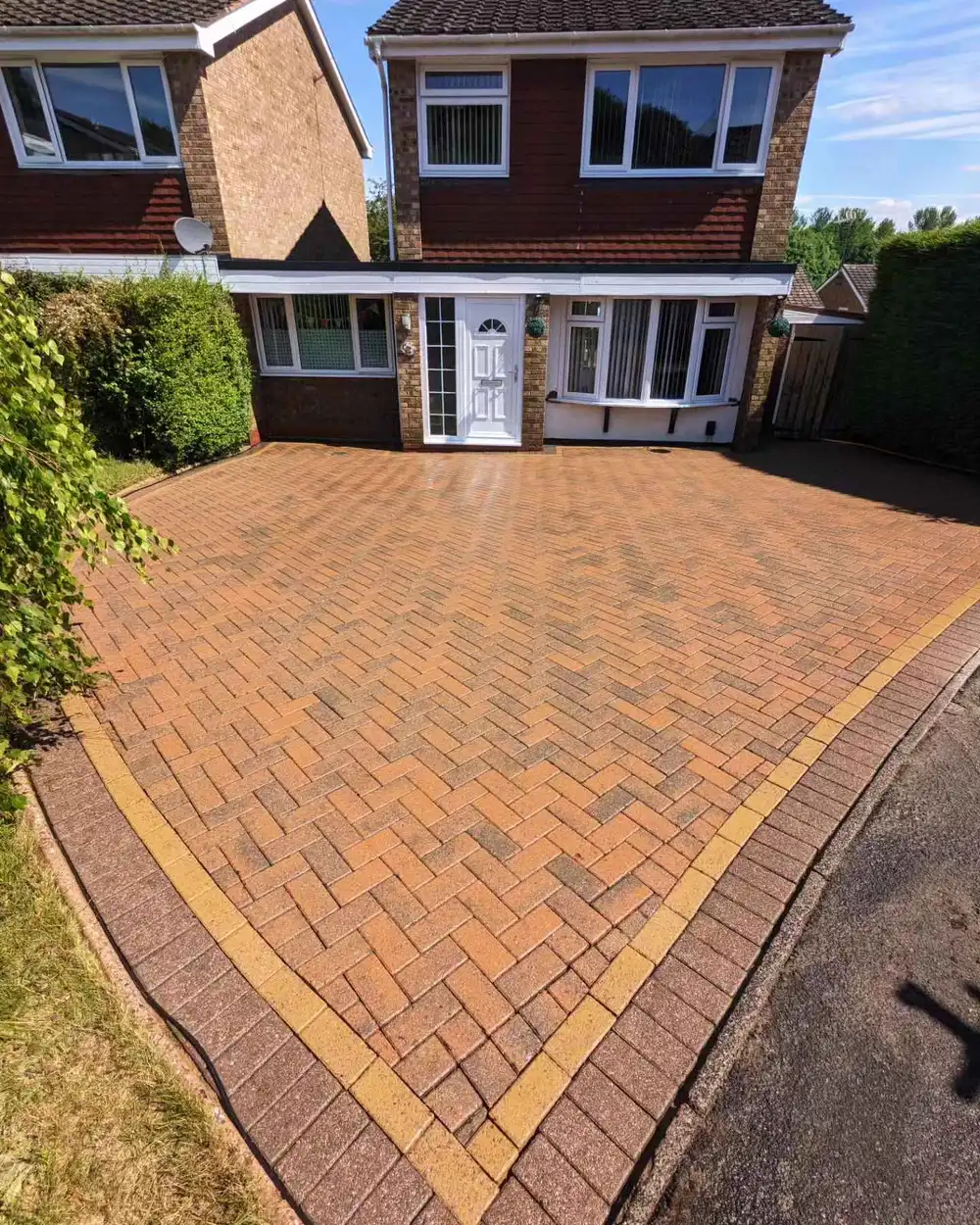
- Driveway cleaning Colchester: By removing the biofilm and applying a residual treatment, we can prevent the Essex humidity from “re-seeding” your driveway for months at a time.
The Gem Solution
At Gem Exterior Cleaning, we don’t just fight the dirt; we fight the biology of the Essex coast. By understanding Colchester’s specific humidity patterns, we use treatments designed to keep your home cleaner for longer, even in the dampest winters.